


If you live in an apartment, condo, or smaller home, choosing the right stroller is not just about style or brand; it's about function, flexibility, and how well it fits into your daily life. From narrow hallways to limited storage, city sidewalks to elevator rides, the right stroller can make life smoother, while the wrong one can feel like a constant obstacle.
This guide breaks everything down so you can find a stroller that works with your space, not against it.
Check if your apartment has a stroller policy
Before you fall in love with a stroller, check your building's rules. Many apartments—especially older buildings or those with narrow hallways—don't allow strollers to be stored in common areas.
Some buildings prohibit leaving strollers in hallways or near stairwells for fire safety reasons, since obstructing egress paths can lead to fines for the building (which then get passed on to you), or worse, your stroller could be removed entirely. Others have designated stroller storage rooms in lobbies or parking garages, though these often come with long waitlists or shared, unsecured spaces that bring their own concerns about theft and mildew.
Why this matters:
If hallway storage is not allowed, your stroller needs to live inside your apartment. That means it should be compact, easy to store, and not something that takes over your entire living room.
What to look for:
- Compact fold size
- Lightweight design for carrying inside daily
- Ability to stand upright or tuck into a corner or behind a door
Even if your building allows hallway storage or has a stroller storage room, it is still smart to choose a stroller that fits comfortably inside your home. Policies can change, and convenience always wins.

Will this stroller fit through my apartment doorways, hallways, and elevator?
Not all strollers are built for tight spaces. Standard interior doorways in the U.S. are typically 30 to 32 inches wide, but with trim, hinges, or angled approaches, the effective clearance can be closer to 26 to 28 inches. Older buildings, charming brownstones, and historic conversions can run noticeably narrower. Elevators, especially in older buildings, can be surprisingly cramped.
Before you buy, grab a tape measure. Measure:
- Your front door
- Hallway width
- Elevator interior
- Any tight corners between your unit and the outside world
Then compare those numbers directly to the stroller's handlebar width and overall frame width. Most full-size strollers range from 20 to 26 inches wide, which generally clears standard doors, but "technically fits" and "fits comfortably" are two very different things.
What to consider before buying:
- Stroller width (especially rear wheel width)
- Turning radius for tight corners
- Ease of navigating narrow hallways
A stroller that glides through your home without scraping walls or requiring a 12‑point turn will make daily life infinitely smoother.
Look for strollers specifically designed for urban or city living, which often come in at 22 inches wide or less. The Baby Trend Passport® Carriage Stroller is just a little over 22 inches and just 20 pounds. It can also transform from an infant carriage to a traditional stroller, so you can start using it from your baby's early weeks and keep using it through the toddler years.

How easily and compactly does it fold for storage in a small space?
If you live in an apartment, storage space is a luxury. Every square foot counts, and a stroller that doesn't fold down small and efficiently is going to become a source of daily frustration.
When comparing compact strollers for small-space living, don't just look at the measurements listed on a spec sheet. Think about where the stroller will actually live in your home day to day.
- Will it fit standing upright in your coat closet?
- Can it slide under your bed or behind the couch?
- Will it share a corner with a shoe rack and a bike?
Look for strollers that fold in just a few intuitive steps, with no extra parts to detach or store separately. The fewer pieces involved in the fold, the fewer pieces you'll lose, forget, or step on in the dark. Simplicity here is everything. When it comes to compact stroller storage in small spaces, the rule is simple: if you have to think hard about how to fold it, it's already too complicated.
The Baby Trend Passport® Cargo Stroller folds up tightly with a one-hand fold mechanism, and can stand upright when folded, giving you more storage options.

Is it easy to unfold and fold one-handed while holding a baby or bags?
Parents rarely have two free hands. You're usually holding a baby, a diaper bag, groceries, or all three. A stroller that requires two hands, multiple steps, or a YouTube tutorial to fold is going to frustrate you fast.
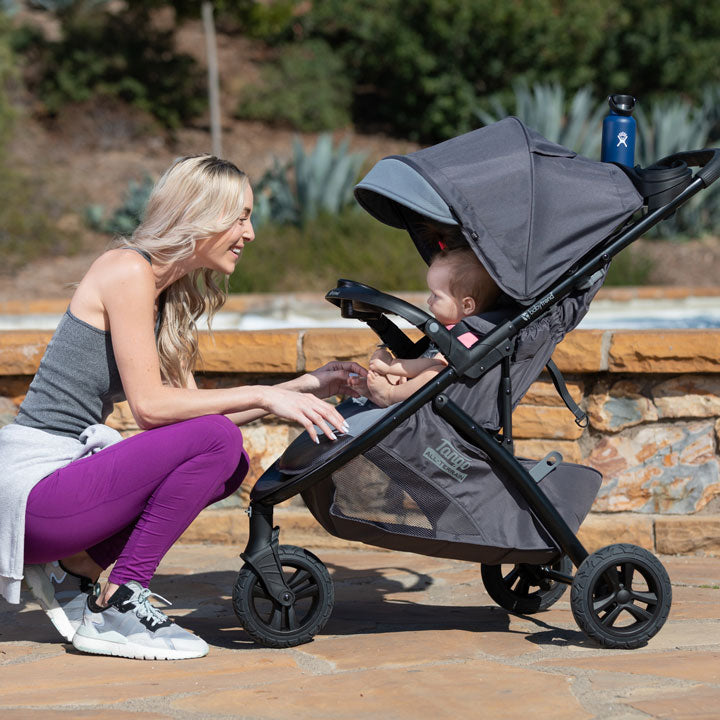
A stroller that has a true one-hand fold:
- Lets you collapse or open the stroller while holding your child
- Helps when you're getting in and out of rideshares
- Simplifies storage in tight spaces
If you can't fold it easily in a store while holding your phone or bag, it won't magically get easier at home.
When shopping, actually practice folding and unfolding the stroller in the store, and do it with one hand. See how natural the motion feels. Pay attention to whether it requires awkward force or a two-hand grip to engage. A stroller that folds beautifully in a product demo but fights you every morning in your narrow apartment hallway is still going to cause you grief.
The Baby Trend Tango™ 3 All-Terrain Stroller has a super fast one-hand fold and can stand upright on its own for easy storage.

Can I lift and carry it comfortably up and down stairs or into my apartment or elevator?
Elevators break down. Buildings have back staircases. Friends live on the third floor of walk-ups. Life happens. And when it does, you'll need to carry your stroller, possibly while it's still occupied, and almost certainly while you're tired.
Stroller weight is one of the single most important factors for apartment parents, and it's one that's easy to underestimate during a quick test drive in a store.
Full-size strollers can weigh anywhere from 20 to 35 pounds. That might sound manageable until you're hauling one up four flights of stairs at 7 a.m. with a 20-pound baby on your hip and a diaper bag on your shoulder.

When comparing models, always pick each one up in the store.
Key points to consider:
- The stroller's total weight
- Whether it has a comfortable carry handle or strap
- How balanced it feels when lifted
- Whether you can carry it while also holding your baby
If you have to carry your stroller daily, even a few extra pounds can feel like a lot over time.
Does it maneuver well in tight indoor spaces, crowded stores, cafes, and busy sidewalks?
Maneuverability is where many otherwise solid strollers fall short for urban apartment parents. A stroller might look fantastic, fold compactly, and weigh almost nothing, but if it steers like a shopping cart with a stuck wheel, your daily errands are going to feel like a full-body workout in the wrong way.
For apartment and city living, you want a stroller with:
- A tight turning radius
- Swivel front wheels
- Smooth steering with one hand
- A slim frame that doesn't bump into displays or tables
Before you buy, test-drive any stroller you're seriously considering by weaving it through tight spaces right there in the store. Pretend you're navigating between restaurant tables, squeezing through a narrow boutique aisle, or pivoting sharply to avoid a crowded city sidewalk.
- How does it respond?
- Does it feel natural and light, or stiff and reluctant?
- How is the handlebar height? Pushing a stroller that forces you to hunch over adds real strain over the course of a full day of city errands, so adjustable handlebars are a meaningful upgrade.
Bonus points if you can comfortably push the stroller one-handed in a straight line, since you'll often need your other hand free for an umbrella, a coffee, or an older child. A stroller should feel like an extension of your movement, not something you constantly fight.

Does it have good suspension and wheels for both indoor and city sidewalk use?
Apartment living in the city means your stroller is going to encounter a wide variety of terrain, often within the same 10-minute outing. Cracked sidewalks, uneven curb drops, subway grates, cobblestone streets, building ramps, and then back across your lobby's smooth tile floor. Your stroller's wheels and suspension system need to handle all of it without rattling your baby into a fussy mood and without requiring serious arm strength to push.
Look for strollers with all-terrain or multi-surface wheels designed for urban environments.
- Foam-filled tires are a popular choice for city parents because they never go flat but still absorb bumps effectively.
- Air-filled tires provide an exceptionally smooth ride over rough pavement but require occasional maintenance and can puncture.
- Hard plastic wheels are generally fine on smooth surfaces but will vibrate noticeably over typical city pavement.
- Front swivel wheels offer excellent maneuverability on flat terrain, while lockable front wheels provide added stability on rougher ground.
Finally, don't forget noise; some stroller wheels are loud on hard indoor flooring. If you live in a quiet building, soft-rolling, non-marking wheels are a thoughtful choice for both you and your neighbors. The ideal apartment-friendly stroller handles gritty city sidewalks just as gracefully as your building's polished lobby floor.
Is it durable enough for frequent indoor/outdoor transitions?
Apartment parents don't use their strollers the same way suburban parents do. You're not doing one leisurely walk a day and then parking it neatly in a three-car garage. You're going in and out multiple times: morning walks, afternoon grocery runs, evening neighborhood strolls, and everything in between.
That level of constant, daily use puts real and meaningful wear and tear on a stroller over time. Add rain, snow, road salt in winter, and the constant cycle of folding and unfolding, and your apartment stroller is essentially a daily commuter vehicle.
When evaluating durability, look at the frame material closely.
- Aluminum frames are lightweight and rust-resistant, making them an excellent choice for rainy city climates.
- Some premium strollers now use carbon fiber for lightness without sacrificing strength.
- The fabric quality matters too; look for materials that are easy to spot-clean and resistant to daily wear, ideally water-resistant and fade-proof.
Most importantly, inspect the folding mechanism and hinges carefully, as these are the components that take the most stress with repeated daily folding. Read reviews specifically from urban parents and apartment dwellers, who are far more likely to report on real-world everyday durability than reviewers who use their stroller twice a week in ideal conditions. A stroller that holds up beautifully through two or three years of apartment life is worth every penny of a higher upfront price.

Does it offer enough storage for errands without becoming bulky or hard to manage?
Here's the classic apartment parent's paradox: you need a small, compact stroller, but you also need it to carry enough stuff to function in real daily life. For apartment families who do most errands on foot — grocery runs, pharmacy trips, coffee shop visits, library days — stroller storage isn't a bonus feature. It's a genuine need. Your stroller basket is essentially your trunk.
The good news is that many of today's compact city strollers have gotten very smart about storage. Look for a generously sized under-seat basket with a weight capacity of at least 10 to 15 pounds, and check whether it's easy to access from the front, especially when the stroller is occupied.
Be sure to check whether the basket remains accessible when the seat is in a reclined position. That's a surprisingly common design flaw that will irritate you daily if you don't catch it before you buy. Handlebar organizer trays or parent consoles with cup holders add convenient on-the-go storage without adding permanent bulk to the frame.
You want:
- Enough room for essentials (diapers, wipes, small purchases)
- A basket that is accessible, even when the seat is reclined
But you do not want:
- Oversized storage that makes the stroller bulky
- Added weight that makes maneuvering harder
Look for thoughtful design:
- Medium-sized under-seat basket
- Optional compact organizers instead of large add-ons
The goal is function without excess.

A critical safety note for lightweight strollers: be very careful about hanging heavy diaper bags or groceries on the handlebar. Because compact strollers are so light, hanging weight on the back drastically alters the center of gravity, and the moment you take your child out of the seat, the stroller can flip backward.
Will it grow with my child, and can it replace the need for multiple bulky baby items in a small living space?
Apartments don't have room for a graveyard of outgrown baby gear. The infant lounger that lasted four months. The bassinet that got used six times. The jogging stroller you bought before realizing your building has no jogging path nearby. Space-conscious parents genuinely need products that grow with their children and pull double — or even triple — duty.

When choosing a stroller with longevity in mind, look for convertible options that accommodate a newborn from day one, either through a full-recline seat, a compatible bassinet attachment, or an infant car seat adapter. The ability to skip a separate infant carrier or full travel system can save you an enormous amount of money, clutter, and storage headache. Modular systems let you adapt as your family grows, and some strollers even accept toddler boards or convert to doubles, which is a huge benefit if you're planning a second child in the same square footage.
Look for extended weight limits (ideally 40 to 50 pounds or more), multi-position seat reclines, and adjustable footrests that support a growing toddler comfortably. Some apartment parents even wheel a fully-upright toddler stroller right up to a dining table, eliminating the need for a separate high chair in tight quarters.
The Baby Trend Morph Single to Double Modular Stroller offers more than a dozen ride configurations, with the ability to change from a single stroller to a double stroller.

The fewer separate items you need to buy, store, and eventually find a way to get rid of in a small apartment, the better your home (and your daily life) will feel. A truly great stroller for apartment living isn't just a stroller. In a small space, it's a long-term investment in your everyday quality of life.
Finding a Stroller That Truly Works for You
Choosing a stroller for apartment living isn't just about style or brand; it's about finding a stroller that works with your space, your building, and your daily routines.
One popular model is the Baby Trend Tango Stroller. It features a quick one-hand fold that is designed to be more compact and even stands upright when folded, making it easy to tuck near an entryway or inside a closet. Pair that with smooth maneuverability and a large, accessible storage basket, and you have a stroller that works just as well in narrow hallways as it does on busy sidewalks.

The right stroller will make your life easier, smoother, and more enjoyable, whether you're navigating a narrow hallway, hopping into an elevator, or taking a quick walk to grab the mail.
